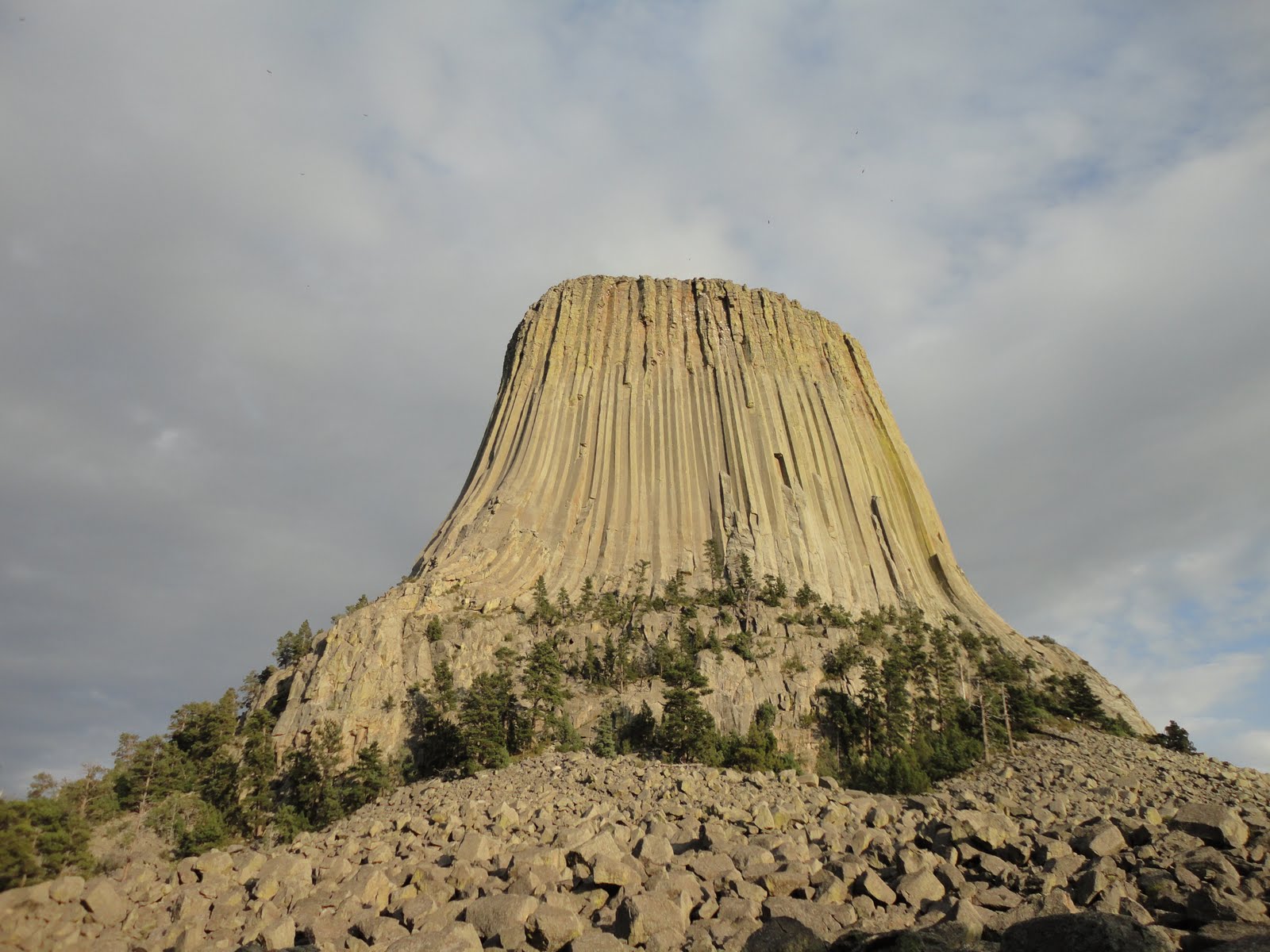
A colleague who knows Wyoming’s and South Dakota’s Black Hills area well said Devils Tower gives off an edgy “not for humans” vibe. That is exactly right. This volcanic oddity rising about 800 feet above rolling hills of prairie grassland and Ponderosa pine forests had been regarded as sacred by Northern Plains tribes as sacred for hundreds of years before it was named “Devils Tower” by whites in the nineteenth century and made the first ever U.S. National Monument in 1906. Most of the photos you see don’t do justice to how different it is from everything else around it. Similarly, most photos don’t quite convey how insignificant a person can feel next to it.
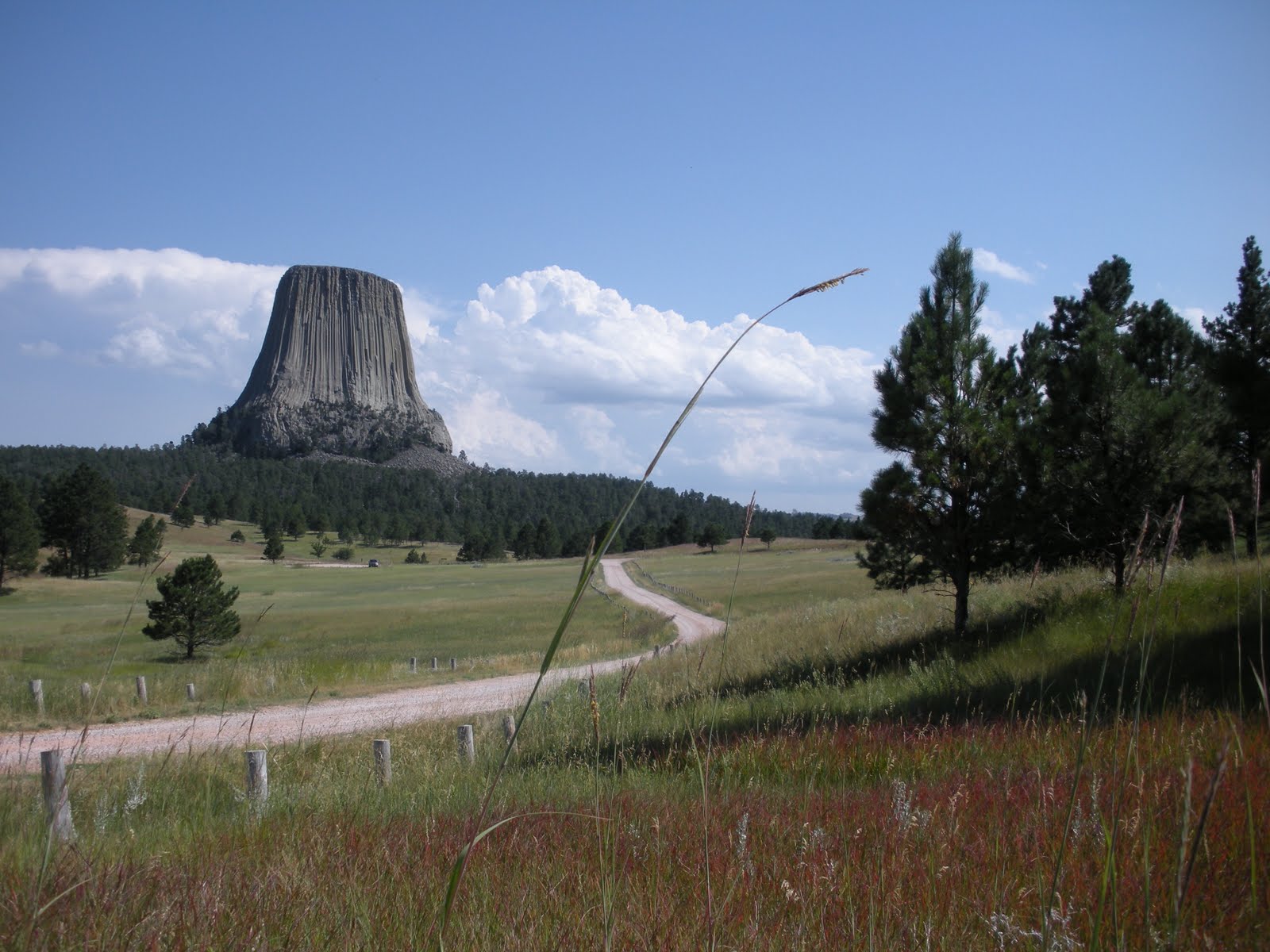
OK, you may get the same effect with real mountains — the Himalayas, say, or even the Rockies — but there is something about Devils Tower, despite it’s being far smaller, that makes you go, kinda like inarticulately: “Wow!”
I reported earlier on this blog that I’d been invited on an outdoor climbing trip by Jay and Abby, a father and daughter climbing duo. Reader, this was it: we were going to climb Devils Tower! On August 17, Jay, Abby, and I headed to Wyoming to attempt climbing this amazing thing.
Some Background, Especially If You’re Not a Climber
A sane, or sane-ish, person might have scaffolded his approach to multi-pitch outdoor climbing from top rope climbing inside a gym a bit better, but whatever. (That’s like going from “I jog two miles once a week” to “I’ll run a marathon next week.”) Jay and Abby are far more experienced than me, and the approach we were going to use didn’t seem so daunting. It was rated as a “difficult 5.7,” and I have progressed to high 5.10s in the gym. If those numbers mean nothing to you, just think “higher number is harder.” Sure, I knew that you drop a couple of decimal points when you move from a gym to the real outdoors (as in, say, from 5.10 to 5.7…) and also that Devils Tower was largely crack climbing, which most gyms don’t really have. And the “difficult” in the description puzzled me some. But, again, whatever.
“Crack climbing?” you interrupt. It’s exactly as it sounds: you get up by taking advantage of the cracks of varying width on the rock, as opposed to features on the rock face. Tape your hands. Expect discomfort.
So, anyway, it was maybe crazy of me to try this, but here we were. We were going to try to climb Devils Tower using the Durrance Route, on the south face of the tower, pioneered in the late 1930s by Jack Durrance and Harrison Butterworth. It’s one of the easiest and most popular routes up the tower.
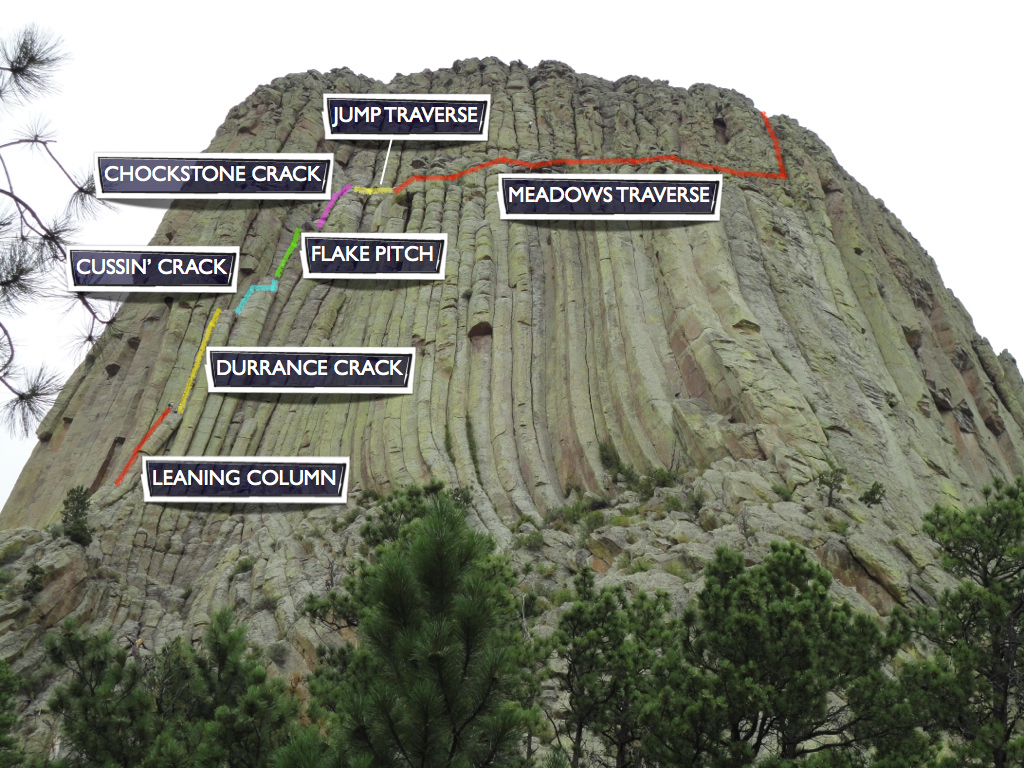
The route has six “technical” pitches. Technical means you had better (a) know how to rock climb and set up belaying stations and place protective gear or (b) know how to rock climb really damned well so you don’t need a partner and protection. Another way of describing technical is to say it’s class 5 by the Yosemite rating scheme: “Technical free climbing involving rope, belaying, and other protection hardware for safety. Un-roped falls can result in severe injury or death.” But even the approach to that “technical” part is pretty strenuous and scary and the last hundred or so feet before the summit are rated as fourth class (“Simple climbing, with exposure. A rope is often used. Natural protection can be easily found. Falls may well be fatal.”). So it’s not a walk in the park, even though you are in an area run by the National Park Service.
Finally, the Actual Climb
We started early, which meant we were on the boulder field approach at 6:30 a.m. In a bit of foreshadowing, I’ll tell you this, dear reader: I had brought two headlamps and a lightweight but powerful flashlight on the trip, but decided to leave them on the campground because I felt there was no way we would run out of daylight, starting at sunset as we did.
Once we got to the beginning of the first pitch, we had to wait a little bit because another climbing party was ahead of us. I wish I could say our slowness was all because of this, but it wasn’t. Even on the approach, we had wandered off a little bit and took a bit longer than would have been necessary.
The first pitch is called Leaning Column, for the screamingly obvious fact that it’s a column of rock that is leaning against the rest of Devils Tower. A few years ago, some climbers reported it wobbling; geologists did measurements and said, “Yes, it wobbles, but humans can’t set it off.” (Remember that “not for humans” thing from the beginning.)
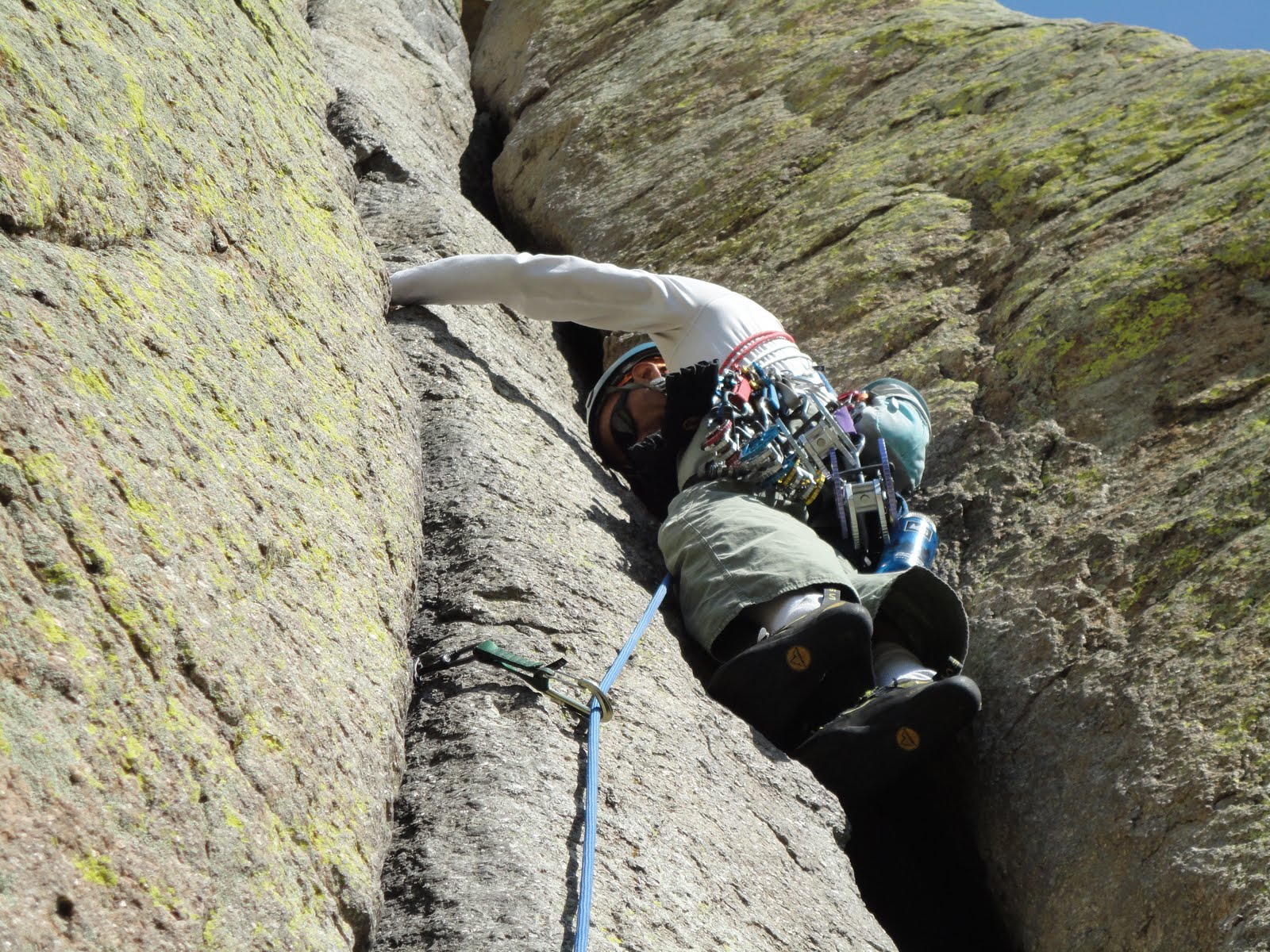
Jay was our leading climber the whole day, which made his job immensely harder than Abby’s or mine. He climbed first, carrying a heavy rack of protection devices (“cams”) on his harness and setting them into the cracks as he went. If that wasn’t hard enough, note that every time he was above a piece of protection he had set, he risked a fall twice the length of his distance from his most recent protection: I was belaying him with a rope from below, but if he fell, there was no way I could shorten the fall. So, to use a highly technical term: stressful shit.
The first pitch made us realize some of these pitches were not going to accommodate the backpacks we were carrying. We hung them from ourselves (heavy!), we had Jay haul them up (heavier yet, for him!), and we squirmed and we squeezed.
The second pitch, the Durrance Crack, was by all prior information the most difficult climb of the route. It was a long and sustained pitch at seventy feet, and it involved puzzling, confusing, scary climbing, even though it was pretty much straight up. The scary, etc., was true for Jay, the leader, but the conditions changed significantly when Abby and I climbed it up, just because Jay was belaying us from above, and there was no meaningful risk of a fall.
The same was true, in spades, for the following pitch, the Cussin’ Crack. OK, I actually had had a plenty of practice on the cussin’ front during the first pitch, but this was even more a significantly different experience for the leader and the following climbers. It was a horrendously annoying crack — imagine you really have to be Santa Claus and get through a chimney with a heavy bag — for the leader. But once the protection was in place, every sane climber avoided the crack and climbed comfortably and fast on the rock face. Even I, dear reader, did that. Which means it was easy.
The next two pitches, the Flake Pitch and Chockstone Crack were supposed to be easier. They were not long, sure, but they had their challenges. We all got up them fine, more or less (the “less,” of course, refers to my climbing).
Amid all this, a two-climber party came up from below and caught up with us. The leader was a seemingly fearless and obviously experienced guy, the second someone who had not climbed in years and was, by his own admission, close to shitting his pants. Despite this, they were faster than us, and we let them jump us. Less stress for everyone. Plus they were perfectly nice.
OK, these have been pretty telegraphic descriptions. If you know multipitch climbing, it’ll make sense to you. But if you don’t, as I didn’t until this trip, you’ll want to know the details.
A Small Interlude that Describes the Process of Climbing
I should, of course, just send you, dear reader, to one of the bazillion sites describing the varieties of multipitch climbing. But here’s the essential idea: Someone leads, placing the protection through which the rope runs. In our case, it’s always Jay. One person belays him. The second climber — Abby — goes up next, carrying a second rope, unclipping the first rope from the protective cams and clipping the second rope she is carrying, tied to her harness, to them. I am tied to the second rope, and when I climb, I “clean,” that is, remove the protection from the face. At that point, I am, like Abby was before, belayed from above by Jay, who has set up a safety anchor.
On Devils Tower, and on the Durrance Route, the nice thing is that someone — probably the National Park Service — has put in extremely sturdy bolts into the rock, and building an anchor and a belaying station is very easy: you just clip your anchor system onto these reliable pieces.
(You may also wonder, as I had, how you don’t freak out on the rock face. It’s because as soon as you arrive at a belay station, you anchor something strong connected to your body to the most reliable protection. So you are not really ever unprotected. In principle. If you want to know about the “in practice” part, read on.)
Back to the Damned Climb
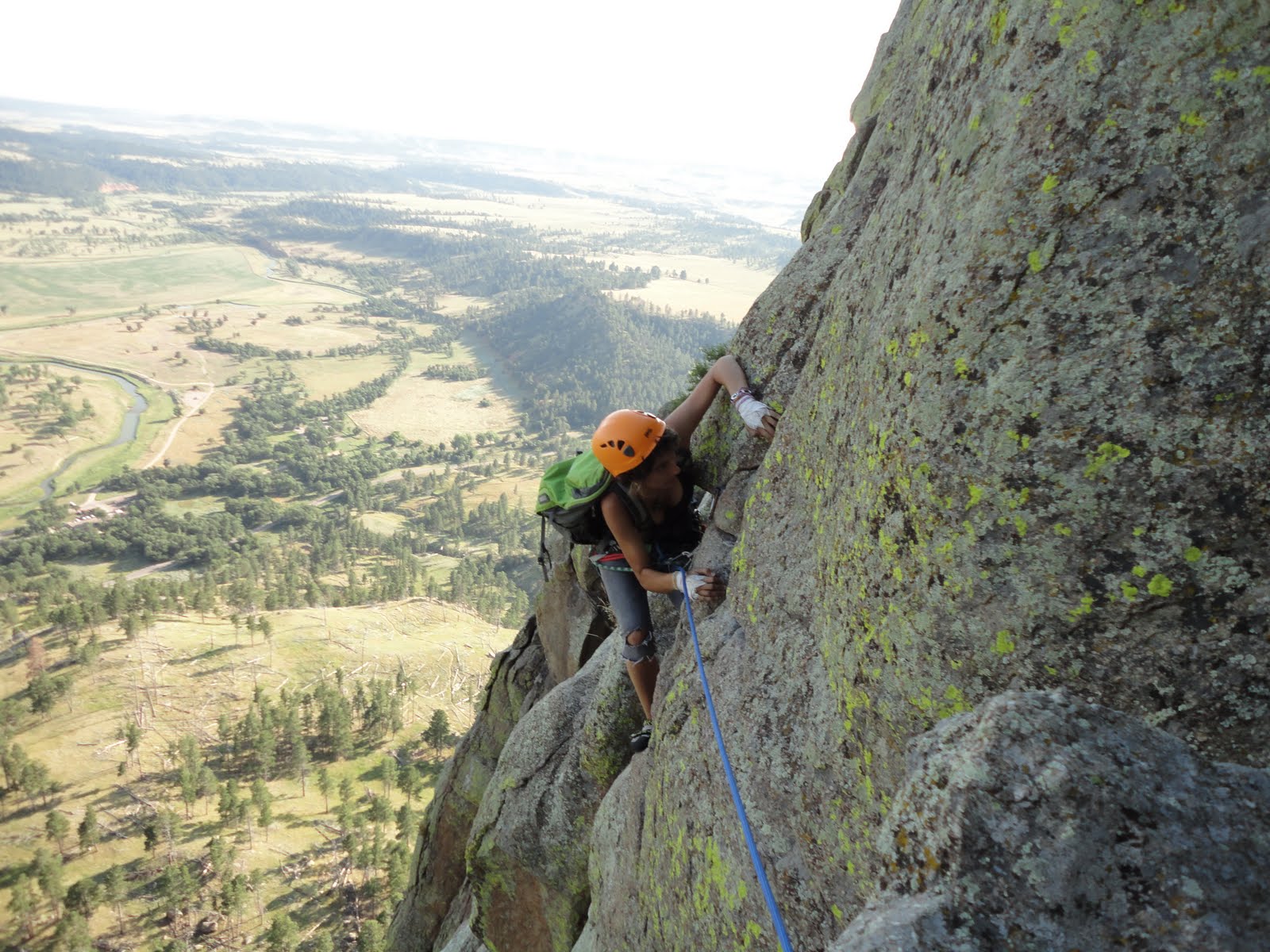 |
| Abby on the Jump Traverse |
After the Chockstone Crack, we had one more technical climb ahead of us: the so-called Jump Traverse. Traverse, of course, means horizontal movement, and y’all can understand what “jump” means. In fact, a jump was not recommended; there was a way of getting over the scary-looking chasm. Jay and Abby managed it beautifully. I did not, but I got across, and as it was getting late in the day and whatever pride I had had was long gone, I didn’t mind.
Now we only had ahead of us an “easy” traverse of about hundred yards and then a fourth class climb to the summit. A couple of problems: we had had seven liters of water for the three of us, but because it had been friggin’ hot, we were pretty much out of it. Jay and I were already slurring our speech, only because our mouths were so dry. (Whatever Abby’s secret was to avoid the fate, I want to know it. Probably it just requires being fifteen, as opposed to forty-something.) The second problem: it was getting late. We had taken a looooooooong time already. But we were so close it probably would have sucked to head back. (That didn’t keep me from advocating just that.) We “short-roped”: tied ourselves together with a thirty-foot rope. It’s not very safe. Ideally, if one person falls, the others can stop that fall. But equally well, that one person falling will drag the others down.
As it was, we made it to the summit. But now we were seriously running out of daylight. And we had four long (about 100 foot) rappels ahead of us. And we didn’t yet quite know where we would rappel down…
Long story short, we found each rappel station, despite increasing senses of panic, and thoughts of spending a night on a 3 x 2 -foot rappel station.
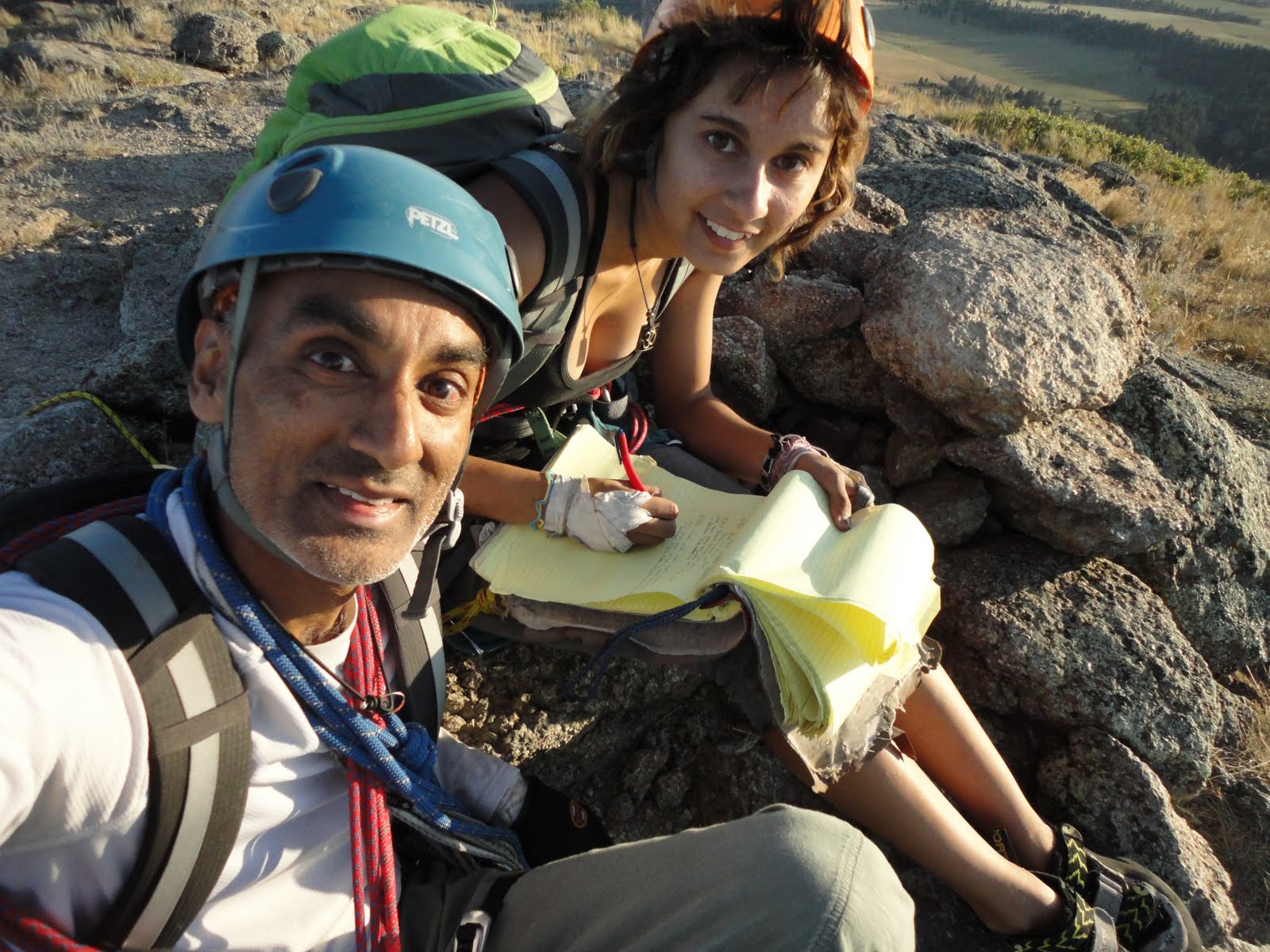
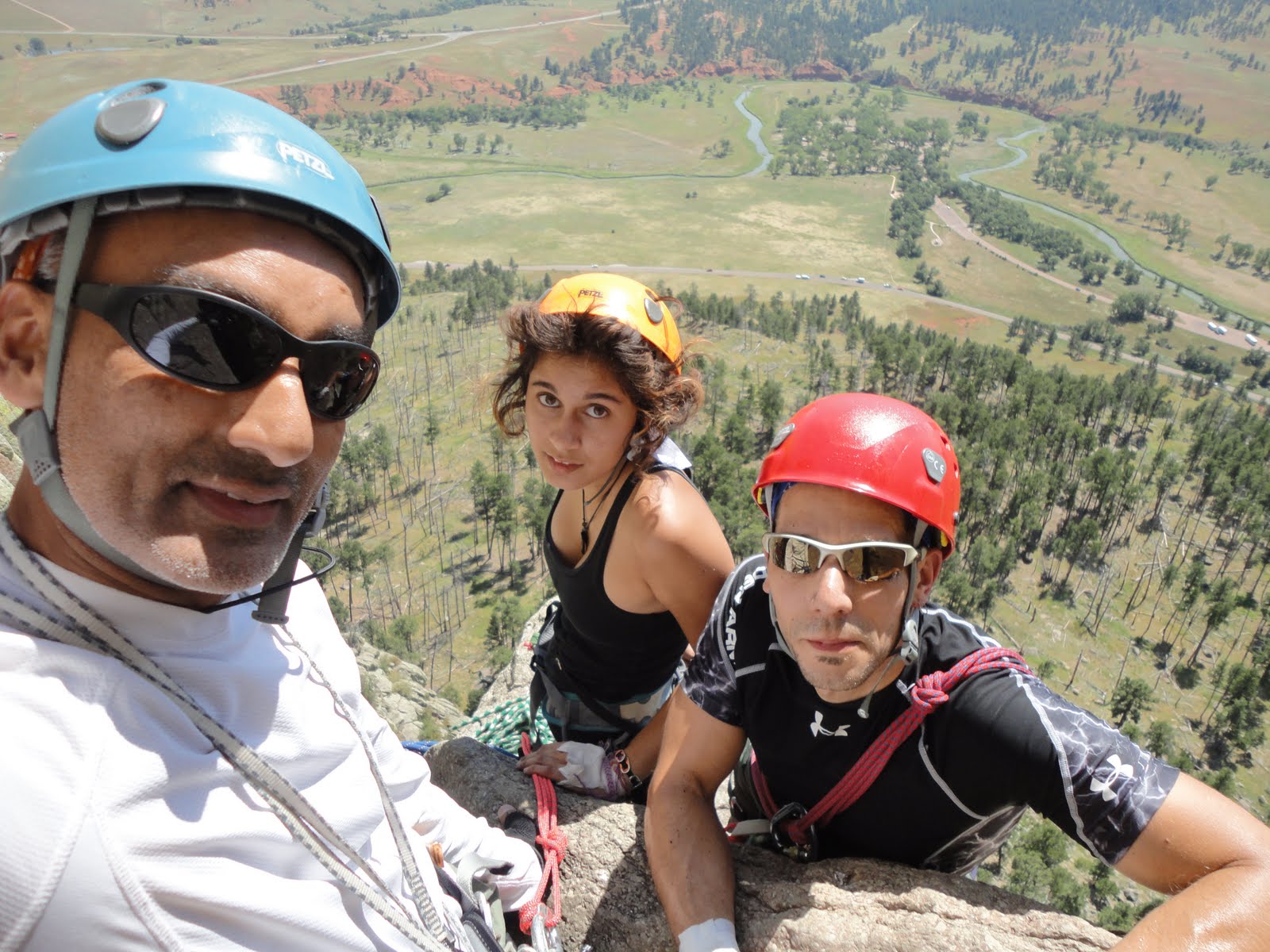
We made it down from the technical stuff at 9 p.m. We had summited at 7:09, twelve and a half hours after beginning the climb. Pathetically slow, and ultimately also pretty scary. And still, darnit!, the most exciting, cool, fun thing I’ve ever done. This is, without a doubt, thanks to Jay and Abby, with whom I’m now willing to travel to hell (and, undoubtedly, back).
 Into the Not So Wild
Great narrative! I'm not nearly as adventurous as you, but it was fun to hear the story.
LikeLike
You are the man bro. I wanna do it with my 63 yr old father n u told me almost all I need to know. Good looking.
LikeLike